“It’s a shame you two didn’t come to
the movies last night. We saw a
wonderfully funny American film. I
forget the name.
I know it was moronic and infantile
and lacking any wit or
believability but John and I
laughed in spite of ourselves.”
In Midnight in Paris, author Gil Pender (Owen Wilson) finds himself magically time travelling to the Paris of the roaring twenties, where he gets to meet some of his great idols like Ernest Hemmingway, J.D. Sallinger, Pablo Picasso, Gertrude Stein and Salvador Dali. This romantic journey of wish fulfillment helps him to overcome his writers block, as well as giving him relief from his strained engagement to his fiancee (played by Rachel McAdams).
It is interesting to reconsider this film when it feels like Midnight in Paris itself begins to feel like a product of its time. Still a relatively recent film from 2011, it nevertheless now precedes events like the Covid Pandemic, the rise of fascist populism and -perhaps more notable here- the rise of the #metoo movement and the disgraceful downfall of Woody Allen as a public figure himself.
There seems to be some asymmetry in the way we look at the past versus our view of the present. Name any decade of the twentieth century, and we can easily conjure images of what its appearance was like: Styles of clothing, musical instrumentation or the type of camera used to record the decade. My mention of the roaring twenties just now may already have spoken to the imagination.
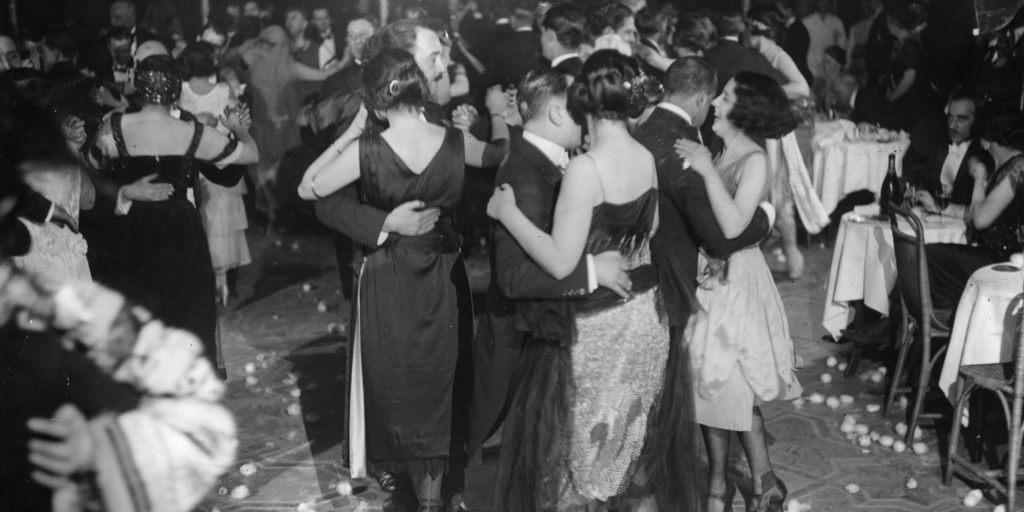
The present, by contrast, is often more difficult to grasp and put into words. Though there may be trends and current events that we can follow and pay attention to, when can only truly define it when we are out of said time period. When we have a new present with which we can contrast the past.1
I slowly feel this happening with the (early) 2010s, especially with the ridicule of the millennials who came of age during that period234. Even as someone who himself graduated high school in that period, I cannot deny that it is very funny to look back on that time now as primarily a source of comedy.
This little post probably won’t crack the code on why our sensation of time works this way. In part it seems to be that hindsight will allow us to have a stronger perspective. Once a certain emotionally charged cultural moment has passed, one can regard it more coolly with the benefit of distance from the event5. Furthermore, the outcome of the past has already occured and is not blinded by the uncertainty of the present. When looking at the past, it is at least theoretically possible to see which societal factors were actual determinant of the outcome of events, whilst the present is flooded with possibilities. For instance, will the current AI-craze actually ammount to something or will it be forgotten like the bag of hot air that NFT’s turned out to be?
On the other hand, we can argue that it only seems like the past is more easy to define. Consider something like an 80s throwback party. To what extend does that actually possess the ability to relive that decade? Look, I am not saying that people who throw these parties are actively trying to revive the past, but more that our fascination and obsession reveals something about the different ways in which the past and the present are experienced.
As way of illustration, let me point to this minor viral video of 2018:
This video attempts to recast the 2011 Gotye hit as if it came from the 80s by using vintage instrumentation and some edited clips. I remember sharing this with friends and trying to gaslight them into thinking that the 2011 version actually was a cover of this version. It was not particularly difficult to debunk my little scheme if you were a little internet savvy. Of particular note should be the B-roll footage used in this clip of a car driving down the highway in home video recording. This footage is distinctly 80s to us and fits the purposes of creating this fake version of the past, but would of course be a baffling inclusion if it were actually made within the time period. That type of footage is only meaningful through the benefit of nostalgic hindsight. In the 80s, it was the unnoticed, unobtrusive present.
Our vision of the past is messy. At once less and more emotionally charged than our perception of the present. Similar ruminations occur within Midnight in Paris itself. For one, it takes a while for Owen Wilson to realise the striking similarities of his own life to that in the past. His own life is marked by an ennui only broken up by the irritations of his love life. Yet at the same time, he is enamored by the romantic struggles of his heroes like Hemmingway, Fitzgerald and Picasso. Are they truly so different?
This theme is further explored later on in the film, once an inception-style twist compells our characters to delve even further into the fast towards the Belle Epoque of painters like Lautrec and Gaugain. When Wilson realises that the heroes of his golden age also pine after their own golden age, he comes to a realisation that eventually makes him face his own present.
The primairy fantasy that this film pleases is one that is often entertained in time travel films: The desire to live the past once again as the present, to see if it really was that enamoring as our nostalgia paints it as. The conclusion of the film is rather sobering, namely that indeed: the past was as the present is. But what makes this film -at least to me- interesting today is how it was told back then.
Like I alluded to earlier, it feels no longer possible to view this film as contemporary. I suppose I’ll start with the elephant in the room Woody Allen’s sexual abuse allegations6. Browsing the internet has only revealed to me that the truth behind these allegations is not very clear cut to ascertain and the whole debate is a can of worms that I don’t feel like spending my precious time on earth on. For now, I will use my quick-and-dirty yardstick that the victim of his alleged abuse has repeatedly restated her allegations and the very open fact that Woody Alleen loved to date teenage girls.
His status as a reprehensible creep -or at the very least the new reputation that sprung from this- colour the experience of watching the film. For one, I am pretty sure it effected my perception of the infidelity of both Owen Wilson’s character and Rachel McAdams, both finding themselves drawn to people outside of their engagement. But whereas Owen Wilson presents a character that feels misunderstood and whose infidelity is romanticized, Rachel McAdams is portrayed as a spoiled nag who ditches Owen Wilson for an insufferable art snob.
That difference in representation between male and female infidelity feels distinctly pre-Metoo. It harkens to a time before the word ‘incel‘, where misunderstood, dorky male lead were the gold standard for an underdog protagonist7. The re-examination of masculinity and its values is still a hotbutton issue nowadays (I only need to nod at Adolescence for that). In that light, I think it is wise to add that I am not trying to argue here that things were better back then. I myself found that these aspects of the film felt dated in retrospect.
But at the same time, film and television seem to operate with an obsession to critique itself to death and exist with a neurotic awareness of its own online discourse. Characters will all but turn to the camera to explain in the clearest possible terms how you are supposed to interpret its uncomfortable moments. And to the credit of Midnight in Paris, the resolution of this infidelity plotline is surprisingly low-stakes and lighthearted. It does not take long for our engaged couple to realise their mutual incompatibility and realise that this means that neither will truly be hurt by the ordeal.
This lightness of the drama is repeated in a place where I found it more profound. Because though I showed how this film deconstructs its own premise to reveal the folly in blind nostalgia, it isn’t really interested in punishing the characters for it. Ultimately, Owen Wilson can have his cake and eat it too. His descent into his romantic fantasy is safely aborted and ultimately weighs as a net positive in his life. There is no moment where Ernest Hemmingway beats the pulp out of Wilson. The deconstruction does not want to unveil a vile and cynical reality. No, our skewed perspective of both present and the past are just a fact of life.
Looking at this film from our current present of 2025, I find myself charmed by this lightness, a lighness which I associate with that time period in general. That association may of course not be entirely accurate, it is also coloured by the fact that I was just a lot younger in 2011, and that youth came paired with a flavour of optimism that I don’t see when I look around myself today. That milennial cringe of the early 2010s that we love to make fun of nowadays at least could make the claim that is was -well- optimistic.
But if we have learned anything today, it is probably that nostalgia works almost by virtue of being inaccurate. And I think that in realising that, nostalgia can be re-appraised into its proper value. I myself -nor anyone else for that matter- should fall into the trap of really believing in the past was as beautiful as it appears. For one, of course, because it will take another decade before the early 2010s will be as nostalgically remembered as the early 00’s are today (I’m just that ahead of the curb). Secondly, because that nostalgia will be as distorted as yesterday’s 80s revivals were, and people weren’t as happy as Daft Punk’s Get Lucky will suggest that we were. And lastly, since even if that naive optimism was real, you shouldn’t want to live in that dream. It was a good thing that -for instance- Hollywood was exposed to be the Predator’s Paradise that it is.
The genie has left the bottle in that respect, and I personally believe that it is the mature thing to do to accept the changes of the world and not stagnate in the memories of the so-called good old days. Because those days probably became ‘good’ at the same time they became ‘old’. Only once they have left can you miss something in them. And what you feel you are missing is less an indication that you should try to restore the past, and more what you should re-present tomorrow.
Notes:
- Even if there were some accurate untimely meditations in the present era that could tell us -for instance- how important AI actually is or something, most likely only retrospect can we confirm its accuracy. ↩︎
- Consider for instance this years’ We Will Never Die, a parody song by Kyle Gordon of the spineless unchallenged optimism of that era’s indie rock like Mumford & Sons or Bastille. ↩︎
- A second example comes to mind in the form of the modern backlash to the early ‘randomn’ age of internet humor: https://www.vox.com/the-highlight/23466389/millennials-cringe-epic-bacon
↩︎ - Or you know, just look up ‘milennial cringe’ and you’ll see what I mean I guess. ↩︎
- Consider for instance, the moral hysteria that allowed the naked greed of the Iraq war to occur. ↩︎
- Some people may complain that the existence of these allegations should morally bar me from discussing his films in a somewhat positive tone. I disagree with this argument, at least in this particular case. As for most films, they certainly weren’t made by only by the accused party, and it feels weird for me to let one man’s misdeed effect the hard work and talent of others. ↩︎
- Perhaps a topic for another post, but here are some examples of more modern mainstream representations of these types of characters: Consider the main antagonist of Ghostbusters 2016, Richa Moorjani’s character’s boyfriend in Season 5 of Fargo, or of course Arthur Fleck from Joker 2019. ↩︎
 Sleeptalking