
Stop me if you have heard this one before: An aging family patriarch is at a crossroads in his middle age. Though he has been professionally succesful, creating a powerful outward image of himself, his private life has deteriorated and he has become estranged from his offspring. Our film follows his attempt to rekindle these relationships through methods of questionable sincerity with a ragtag bunch of oddball outcasts.
That description fits many films in Anderson’s filmopgraphy, from The Royal Tenenbaums (2001), The Life Aquatic with Steve Zissou (2004) as well as Fantastic Mr. Fox (2009). Maybe that is why throughout his latest feature –The Phoenician Scheme– I was half anticipating some sort of twist that never seemed to come.
Perhaps this is partly due to the more personal subject of this film. Most of Anderson’s film are bookended by citing a clear inspiration. Wether that was the work of Jean Jacques Cousteau for the aforementioned Life Aquatic, the writings of Stefan Zweig for The Grand Budapest Hotel (2014) or the grandmasters of journalistic prose for the French Dispatch (2021). Here, the work is dedicated to and inspired by Fouad Malouf. This is Anderson’s late real life father-in-law, who was gentle, wise and intimidating in equal measure. Maybe without having direct familiarity with the subject of this film, it may be a bit harder to relate to.
But more likely is the lack of a break from Anderson’s signature style. His look and feel is of course a great draw for his film: A-list actors playing outcast characters delivering 100-mile-a-minute deadpan dialogue within dollhouse-like set design drenched in oversaturated colours. It is a style we all know and love: At once very in your face but simultanuously feeling like it isn’t trying at all. It is a style that lends itself well to comedy, mostly through the timing of line delivery or the composition of scenes alone. Actual visual comedy (instead of improv that happened to be filmed) is still a rarity within theaters nowadays, so I want to make sure that Anderson gets his flowers for that.
Similarly, I was impressed by a type of shot that recurred throughout the film. Notice the image I used at the beginning of my post and you’ll get an idea: Lots of action and detail in the margin with plenty of ‘dead space’ in the middle, yet never feeling like a composition that is off balance. Kind of reminiscent of Rembrandt’s portrait of his son Titus, which so cleverly draws the eye that you never notice the unused space in the image.
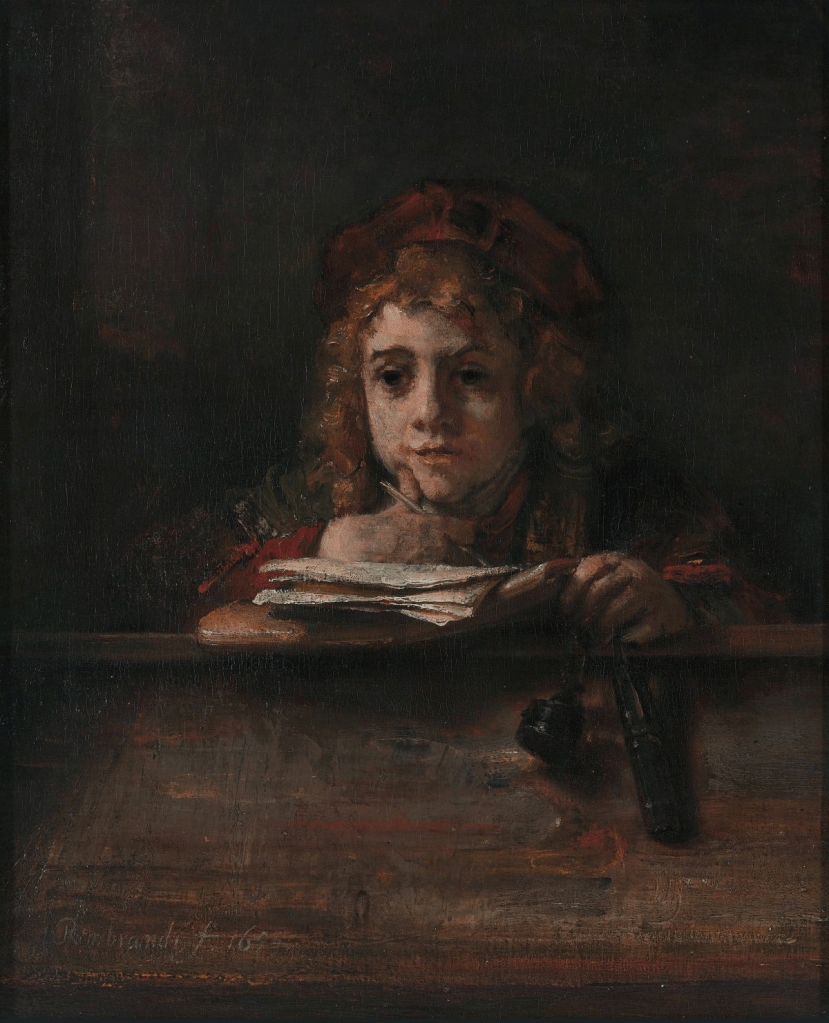
But like I said, though Anderson’s style has its effective uses, I felt myself waiting for it to fall apart. This is my strongest held belief about Anderson’s work: His films work best whenever his crafted illusion has a chance to dissolve.
After all, his artificial style makes films with heavy themes more lighthearted. Anderson is not interested in dwelling on the heartache of his characters with dramatic closeups and melancholic string quartets. No, he would prefer to keep up the illusion that his own characters are trying to uphold, hurrying past the uncomfortable reality of their lifes with breakneck editing, untill the weight becomes too much to bear and the Wes Anderson whimsey comes crashing down.
Think of the following scenes: The wristcutting of The Royal Tenenbaums. Adrien Brody holding a dead child in The Darjeerling Lmt. The contrast between the Grand Budapest Hotel as held by Zero versus the one from Gustave’s time. The meeting with the Jaguar Shark in The Life Aquatic (or Bill Murray holding his dead son in said film. That just seems to keep happening). Anyway, most if not all of his films seem to hold some sort of reckoning like this, a chance for us to have it sink in what we were actually being told.
These types of scenes are arguably in the Phoenician Scheme, in which I refer to the black-and-white ‘Biblical’ scenes from the film. I’ll concede that Anderson’s comedic take on these mythical scenes are both funny and surreal, not something I can claim to have seen before. But though they take place in a different world, they still are of Anderson’s universe.
That is my main issue with The Phoenician Scheme, a missing piece that would have sold me on the drama that this film tries to convey. This is compounded by the main relation of Zsa Zsa Korda (Benicio del Toro) and Sister Lieszl (Mia Threapleton), which also doesn’t feel as resonant as the other parental relationships from Anderson’s films.
Sister Lieszl isn’t as emotionally needy as the brothers from The Darjeerling Lmt or Owen Wilson in the Life Aquatic. She has her own strong code of ethics, coming across as more self assured and more directly confrontational with her father. This certainly breaks the mold from the usual Wes Anderson playbook, but weakens the emotional thrust behind this relationship. The fact that their relation is formulated as being on a “trial period” with other potential candidates waiting in the wings to fill Lieszl’s shoes never made me convinced that these two really needed each other.
That about sums up my thoughts on the film. Though there were definitely elements that give this one its unique character, overall it lacked the emotional resonance that elevates his films above the style-pieces that his Tiktok fanbase loves to pretend his films are.
The more interesting question is: What is next for Wes Anderson? I criticized this one for lacking an element that his earlier films had, but I don’t necessairily just want a Life Aquatic 2.0. Because arguably, that was already what this film was. I rather see him branch out frankly. Wether that is styllistically like his stop motion work or conceptually like in Asteroid City (2023).
Apparantly, this is the first time where Anderson doesn’t know what is next for him. So take my advice: Throw out the playbook, and help yourself to a hand grenade.
Sources:
Interview with Wes Anderson on his late father in law: https://www.youtube.com/watch?v=rmYPCeRgDW0
Interview with Wes Anderson where he mentions his lack of immediate ideas for the future: https://www.youtube.com/watch?v=NEOvfStFSvM
 Sleeptalking
